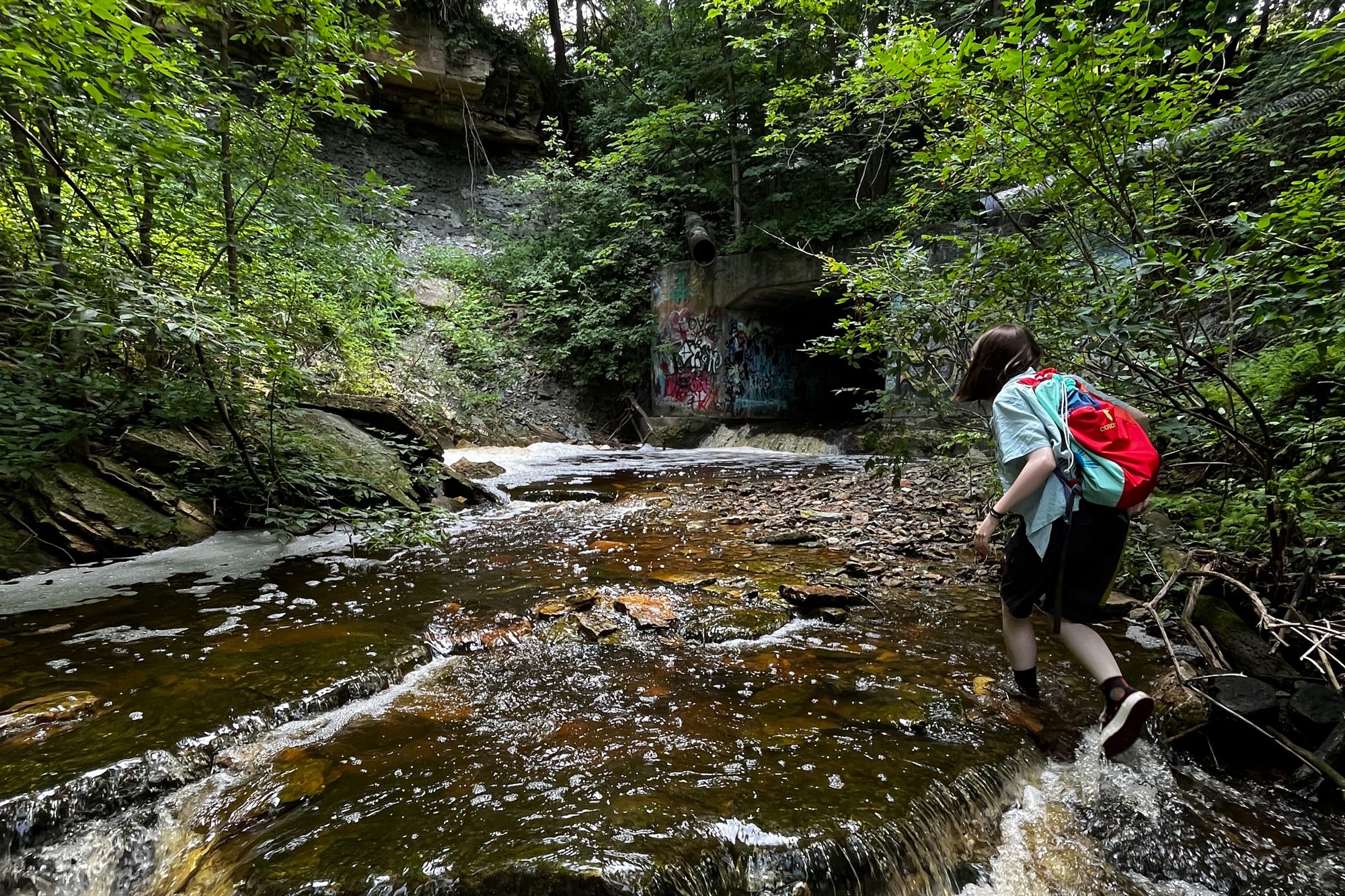
I don’t remember the exact train of thought that led Frida and me to declare this Summer “Frida & Alex Fossil Summer 2026.” Turns out that it was an excellent train of thought. We’re both interested in geology and fossils, and it’s nice to have a reason to get outdoors. (And, paternalistically speaking, Frida’s going off to college in August, so I’m feeling a little pressed for time.)
We’re also both interested in tinned fish. For me, this was a taste that I picked up from my dad, who often packed cans of sardines in mustard sauce in his lunches. My mom didn’t like the smell, so if he ate these at home, he ate them in the garage; which I thought was incredible. It didn’t hurt that the package had a little devil with a pitchfork, the whole thing seemed joyful and forbidden.
More recently sardines have been a minority taste here in our household. My wife also does not care to be in the same room with an open tin of sardines. So, I’d keep a little stash to enjoy alone in shame. However, formerly fussy eater Frida is making up for lost time, having been charmed by a certain YouTube fish influencer with a fez. If you haven’t stumbled upon Tinned Fish Review, then you’re in for a treat (that comes in tins).
This is all to say that tinned fish is the official snack of Frida and Alex’s Fossil Summer 2026. And yes, t-shirts have been ordered and will be worn on future expeditions. There may be other merch was well.
For our first expedition (FAFS26-01), we chose Wequiock Falls and a journey into the Ordovician Epoch (between 450 and 485 million years ago). Why? It’s probably the fossil bed closest to home, making it an obvious choice. Wequiock Falls is a waterfall just northeast of Green Bay, near the university. It’s worth visiting year round, with wonderful ice formations in Winter, snow melt in Spring, and occasional rushes of water when there’s been a lot of rainfall in Summer. By early Fall, it’s fairly dry. It’s one of my favorite destinations for a 20-mile bike ride. Here’s a photo I took the last time Frida and I went there together, on a not too unpleasant day in January 2024.

Today, it looked like this:

If you look at rock face behind the waterfall, you’ll see the geology of this area. About halfway up, you can see the Maquoketa Formation. This is a Late Ordovician formation of shaly “mudstone” that was deposited more than 450 million years ago. At the time, Wisconsin was under a shallow, tropical sea. Walking along the gorge at Wequiock, you can that it absolutely teemed with sea life. The blue/green mudstone shale erodes with just a little pressure, because of its softness and granularity. Over time, it crumbles, causing rocks from the formation above to crash to the ground, forming a new water fall’s edge. Over the past 11,000 years, this has caused the Falls to retreat more than 600 feet! (UW-Green Bay Professor, Steve Dutch has an excellent page on Wequiock Falls). The formation on top of the Maquoketa Formation is Silurian Dolomite related to the Niagara Escarpment. It’s much harder and doesn’t have many fossils, so it’s not very relevant here. You can see it begin about halfway up the wall.
If you live around here, Silurian dolomite is everywhere, especially in Door County. If you’ve hiked the Eagle Trail at Peninsula State Park, you’ve been much more than up to your eyeballs in the stuff. The Niagara Escarpment is large enough a formation that it stretches from Highcliff State Park on the shore of Lake Winnebago, through Manitoulin Island, Canada’s version of Door County—the “Bruce”—and ultimately to Niagara, where it puts on its best show. The Maquoketa shales, however, are quieter and much harder to engage. Around here, the formation is mostly beneath us, running under the Bay or buried in glacial till. Which is a shame, because in its soft tissues, it is like a series of snapshots of subtidal ecosystems.

Practical Things

I won’t bother with directions, this is 2026, you have Google Maps or something.
You will want:
- Bug spray
- Sun tan lotion
- Shorts, or at least pants you can roll up. You will get wet.
- Watershoes
- Water (stay hydrated!)
You will park your car, find your way across the bridge in front of you, and continue to the right, until you find the staircase that brings you to the gorge. At the foot of the stairs, the Falls will be to your left and a tunnel to your right. While the Falls are wonderful, the fossils you’re looking for are through the creepy tunnel. When you reach the other side, you will find shale mudstone rock faces. This is the area where you will begin to find countless brachiopods and other fossilized fauna embedded in shale matrices. Some of our favorite finds, however, were just lying on the ground beneath our feet.
What we found

We believe this is the fossilized base of a Grewingkia. This was a cone shaped coral that primarily lived in Indiana and Ohio during the Ordovician Era. It’s really quite something to hold the fossilized imprint of an animal that lived nearly 500 million years ago!

Here, you can plainly see the shale matrix, and within it, the clear form of a Brachiopod. These were among the most successful animals of the epoch, being incredibly abundant—as the fossil beds of Wequiock testify.

The shale of FAFS26-01-003 has a little more diversity. In addition to the brachiopod at bottom left, you have evidence of other elements of the ecosystem, perhaps corals and crinoid stems. 450+ million years ago, this would have been a riot of color.

This was among the largest of the brachiopods we found.

This appears to be part of a crinoid stem. Crinoids were (still are) graceful, long stemmed animals that “flowered” at their tip. Imagine what these must have been like, with stems many meters long and a mass of petal-like protuberances coming out dramatically at the top, like so:

Apparently, these fossils were abundant enough that people all over the world have used cross-sections of their stems as beads in their jewelry!

Not bad for our first expedition!
Tinned Fish Review
We tried this:

I picked this up (and the next several tinned fishes) at World Market in Appleton. Apparently there’s enough of a tinned fish trend to significantly impact retail merchandising, because there was an entire section devoted to the stuff. Watch out fisheries! This seemed like a good prospect, I’ve always enjoyed North African cuisine. I wasn’t disappointed.
I have mostly been eating sardines made by Wild Planet, which are nice, but not particularly interesting from a culinary standpoint. So I was excited to try something different. Immediately, it was evident that these are a higher grade of sardine than I’m used to, they were even packed in extra virgin olive oil. The skin was thin and more shimmery, and the body of the fish was firmer. It was definitely mashable, but it held up. Yet, it felt light and delicate. The flavor was very nice, less “fishy” than I’m accustomed to. And while the flavor of the preserved lemon was nice, it was subtle. I enjoyed it, but I would have enjoyed some stronger citrus flavors. The sliver of preserved lemon was nice eaten with the sardine. All in all, I was impressed. 4 sardines out of 5. (I’m going to calibrate this scale so that Wild Planet—my reference sardine—is 3 sardines.)
Frida enjoyed it also. We’re both looking forward to more!

Comments
3 responses to “Wequiock Falls / Sardines with Preserved Lemon, Fishwife (FAFS_01)”
[…] (This is the third in a series of field reports and tinned fish reviews, forming a component of Frida and Alex’s Fossil Summer 2026. The first of these is here.) […]
[…] (This is the second in a series of field reports and tinned fish reviews, forming a component of Frida and Alex’s Fossil Summer 2026. The first of these is here.) […]
[…] (This is the fourth in a series of field reports and tinned fish reviews, forming a part of the series Frida and Alex’s Fossil Summer 2026. The first of these is here.) […]