Growing up in Green Bay, you knew that Ashland Avenue turns into Wisconsin Highway 32, and that the signs for WI-32 have red arrows piercing a red line on them. Unless you come from a military family or are steeped in military history, you may not have thought about it much. That’s unusual, I thought, I wonder what that means. I should look that up. I just figured that some highway signs have red arrows piercing red lines on them. Must be something to do with tourism?
I didn’t know that the 32nd Infantry Division of the US Army was based in Wisconsin and Michigan, was known as Les Terribles for the action they saw in World War I, and earned their symbol by being the first division to penetrate the German defensive Hindenburg Line. Not until very recently. I’m not a student of war.
A memorial is not a memorial if it doesn’t attempt to explain itself.
The purpose of a memorial is to remind us about something important. In this case, the sacrifice that our fellow Wisconsinites made to… I can’t finish that sentence, I’ve never been able to explain World War I. We were there to support our allies, that seems like safe ground. We were there to end all wars? That seems shaky. When I was a kid, there were living World War I veterans in the community; I remember seeing them walking slowly in parades1. Some may have even had one in their family2. If that was the case, then they probably felt a sense of pride when you took WI-32 to Greenleaf, or flipped on Channel 32 to watch M.A.S.H. reruns. But all of that was lost on me. I felt nothing. As I’ve written elsewhere, I’m a second generation Californian-Wisconsite. I’m still assimilating. The people who establish the memorials don’t seem to understand that context dwindles.
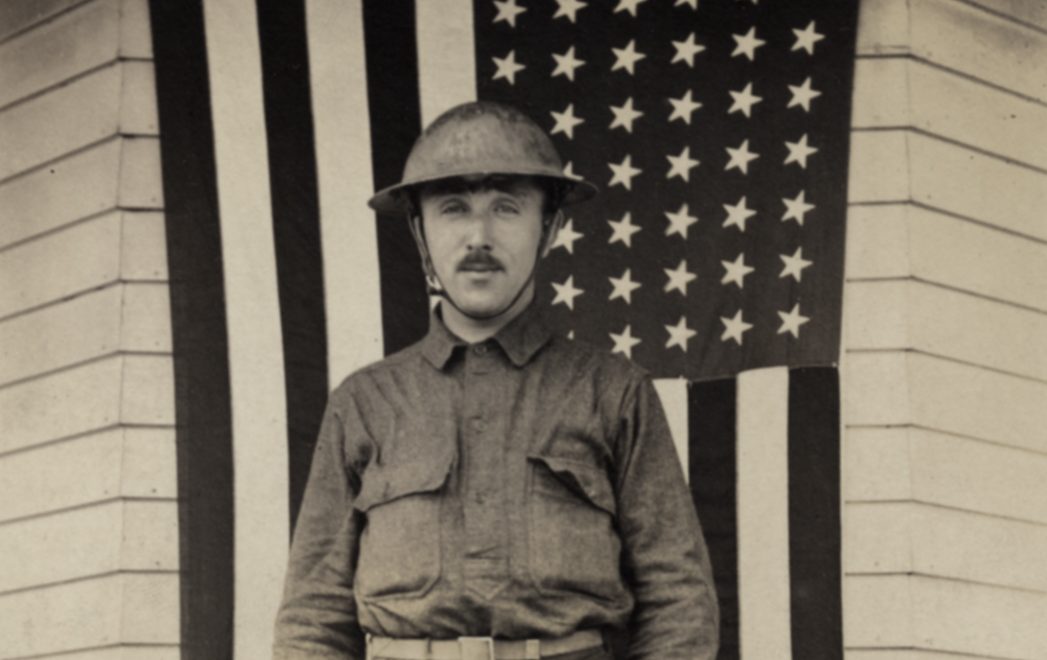
Over a century ago, 1,000s of young men mustered from NE Wisconsin and were sent to France where they fought in three major offensives. Many of them didn’t return. The doughboy at the top of this page looks to me like he’d seen enough of the world. At least for a while.
In May or June of 1919, the 32nd Infantry Division came home and Green Bay threw a parade for them. 107 years later I found some snap shots in a box at an antique mall a block from that parade route.

Washington St.

Washington St.

The Kellogg Building kitty corner to the Bellin Building, Washington and Walnut Streets.

Broadway Avenue

Washington St. The Model T Fords would have been virtually all of the Model Ts in the area and were likely part of the parade.

Bystanders.
It’s worth looking through bins of old photos, you never know what you might find or where it might lead you.
These photos are in the public domain, please feel free to use these jpegs.
1. An 18 year old soldier in 1918 would have been 80 years old when I was 6.
2. We didn’t. But my Great Grandfather Max Witt had immigrated (illegally) to the US to avoid fighting in the Kaiser’s war just prior to the beginning of the conflict. He wanted no part of it. Evidently, what he wanted was to play mandolin in a string band in Texas.